 In the UK nursing covers are still relatively uncommon - at least "Oop North" where I live they are rarely seen, but then so are breastfeeding babies. I've only seen a cover used once, in a cafe whilst feeding my youngest. Perhaps because they aren't seen very often, I did think it a tad ironic that nobody even glanced at me feeding my son, whilst people were nearly falling off their chairs craning their necks to see what the wiggly floral package in the corner was - but I appreciate this is not the case everywhere.
In order to understand why in some areas breastfeeding covers have become so popular, we need to look at cultural norms.
Mother Nature didn't bank on breasts becoming taboo; sure they're placed in the most obvious location in terms of convenience, but social norms demand women (not men) now keep them covered - which obviously throws feeding an infant from them into rather interesting territory.
Discomfort with breastfeeding in public has been identified as a contributing factor in shaping infant feeding choice and the decision to stop breastfeeding in particular (McIntyre et al 1999; Smyth, 2008).A paper by Kate Boyer also adds:
Breastfeeding outside the home is still relatively uncommon in the UK (Stewart-Knox et al, 2003; Tarrant and Kearney, 2008). This is problematic because decisions about infant feeding choice are influenced by women’s perceptions about how acceptable (or not) it is to breastfeed in public (McIntyre etal.,1999). Breastfeeding is not protected by law in the UK outside of Scotland, and there are strong social expectations that it be‘‘discreet’’, i.e.conducted in such a way that the breast is never actually visible (Bolling, 2006;Pain,etal.,2001).12Aint that the truth?
Kate interviewed a small group of breastfeeding mothers about their perceptions of feeding in public, I think their comments echo many I have heard before:
CR remarked that ‘‘if you get your boob out and expose yourself it’s a little bit wrong’’. Indeed BL put it even more bluntly: ‘‘you get the eco-warrior types that are kind of like well it’s my right to breastfeed in public, and I’ll make a big scene of it, and I think that’s a bit unnecessary’’.So for some women the choice is not breastfeeding, or feeding with a cover. Some express difficulty being discreet because of the positions they use, or because the size of their breasts, or because their baby likes to pull off and look round mid feed - It can be hard to feed "discreetly" at times, if discreet means never showing an inch of skin.
These comments convey some of the factors which can make breastfeeding outside the home a daunting prospect for some women, including lack of familial support or a broader cultural context in which it is normalized. They suggest the anxiety–and in some cases antipathy–that can exist toward breastfeeding in public that is not sufficiently discreet, even on the part of women who have recently breastfeed in public themselves. Echoing the findings of Carpenter (2006), they convey the notion of breast-feeding as a public performance that is vetted by others.
As the above highlights, being able to meet social expectations is a big factor for many in their feeding decision. As one Facebook user recently stated: some women aren't interested in the big picture of changing culture, they just want to get on and feed their baby - and I totally agree with this! If the only way a woman can bear to feed outside the home is with a cover, and the alternative is stopping breastfeeding - we absolutely have to hear what these mums are saying and respect their choices, encourage them, understand where they're coming from and realise why.
Does that mean we should all ignore the bigger picture and pretend it doesn't exist? Absolutely not! For other mothers want to provoke change, to remove the social boundaries above that hinder women in the first place - and we also have to respect, encourage and understand these women too!
For many women, breastfeeding in public is daunting the first few times you do it.
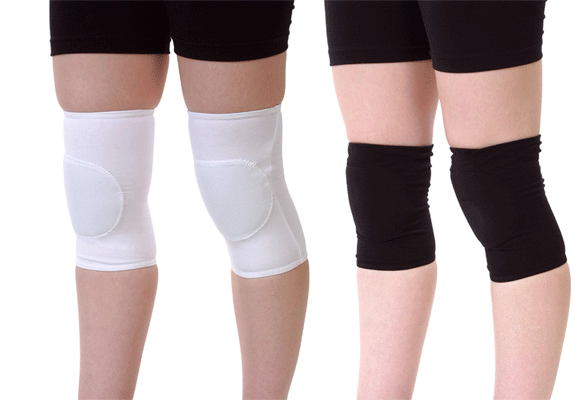

Suddenly you have to feed a child from this same knee! You very rarely see anyone else knee feeding, and if you do the mum is always being extremely discreet so as not to show any knee skin. How would you feel about whipping your knee out? It's not normal to see knees in this context, it's scary - others may judge whether an appropriate amount is being exposed. It's totally normal to feel nervous at first until it's normalised to you!
This cultural change has only come about since the 1940s - my mum has told me my grandad (her father in law) wasn't at all embarrassed when she was breastfeeding me. He had grown up seeing women feed their babies anywhere and everywhere, and he once mentioned as a boy he would often be squished up against a nursing mum on the bus home!
Normal is to us what we see everyday.
Therefore you will find in areas nursing covers have become popular, their use is not limited purely to those who would otherwise have not breastfeed - they become "the trend" for other mothers too. When I sat in the cafe with the mum with a cover, I felt strangely exposed - as though I was being all brazen doing it out in the open, compared to the modest mum in the corner. And that's from someone who has breastfed pretty much everywhere and anywhere since those first few very nervous feeds outdoors!
If we saw most mothers breastfeeding and a few here and there using a cover - the covers would have no significance in the big picture. But we don't see nursing mums everywhere, and so covers becoming popular can quickly become "the social norm", which rapidly morphs into "a social expectation".
And you know what - cover manufacturers know this. So much so the company above gives out a free cover to all mums. I've watched the threads on forums - one person shares the offer, people love a freebie and so will join in and get one; more so if a few others do it first and report it all great. Before long most mums who are pregnant will have signed up for the free cover, they may plan to breastfeed (or try to) and so a cover is the logical accessory right?
Some ask what the difference is between using something else to cover breastfeeding and buying a specific cover. But the latter is an item specifically bought to cover breastfeeding up - whether we intend it so or not, that can also send the message it should be covered, and being covered requires a special item to do so it's so important.
I was quite shocked when a debate on this topic broke out on a predominantly US Facebook page. The debate quickly shifted from whether covers were discreet - to a not insignificant number of breastfeeding mothers saying it was indiscreet to feed without a cover! That when there is an item to ensure not a fleck of skin should be seen - you should use it to ensure modesty.
In some ways suggesting every women who feels nervous at feeding in public uses a cover - is akin to suggesting everyone having an "ugly day", wears a paper bag over their head. If they feel so ugly they wont go out in public without, isn't the bag a good thing? But others want to tell these women they don't need to cover up! They feel regardless of how things look, nobody is really paying much attention and the more that go "bagless", the more others will feel empowered to as well. How they look is totally normal and doesn't need covering to be acceptable.
We have to see that both the big and small picture to effectively provoke change, and we have to acknowledge the language we use and that of those around us.
To conclude and almost come full circle, I thought I would share some the latest marketing offering from Udder Covers that plopped into my mailbox. I've highlighted in red all the statements that undermine normal breastfeeding, and serve to perpetuate a culture that feels breastfeeding should be done, but not seen:
Breastfeeding is a natural thing, but also a huge source of awkwardness for many women who nourish their little one in a public place. However, breastfeeding covers help lessen this discomfort and make it simple to do. While many people avert their eyes when they understand that you are tending your child, you are always nervous about who is watching (AA - If you weren't you are now!). You can be modest and keep your child comfy by using these covers that are now available in all kinds of colors and designs.
Most people will try using blankets or towels to conceal them while feeding but this can fall off or slither away if they aren’t alert.
Plenty of people are a bit awkward around breastfeeding moms and you can reduce the embarrassment by using the covers. (AA -Wow just in case you weren't feeling quite uncomfortable enough already, a guilt trip thrown in as well)
The shield also helps stop your newborn from distraction during breastfeeding by aiding their focus on you. This ensures the feed runs a lot smoother and quicker compared to not using a shield. (AA - Really is this an evidence based comment? The feedback I hear is that for as many who find it helps with distraction, others will not feed well due to having fabric over their head!)
The discrete way fashionable breastfeeding covers make it simple for you to feed your infant quickly means you can safely give food to in the busiest environments (AA - Wow now not using a cover is unsafe!) without fear of awkwardness or causing any uncomfortable moments.
Coming up next - alternatives to covers if you feel self conscious.

0 comments:
Post a Comment